
Nurse Practitioners (NP) and Physician Assistants (PA) are advanced healthcare professionals found in many health organizations. At first glance, determining the differences between the occupations might not be clear. Both NPs and PAs treat illnesses, prescribe medications, and work closely with primary care physicians. What Career is Right For You?
 Some of the responsibilities of both positions are:
- Prescribe medication
- Obtain medical histories
- Perform physical assessments and examinations
- Diagnose and treat common illnesses and injuries
- Administer vaccinations, screenings and physicals
- Perform and interpret diagnostic and laboratory studies
- Counsel and teach health and nutrition
- Screen and refer patients to specialists and other health care providers
The amount of overlap may surprise you but NPs and APs are not identical positions. Each has its own specific role in the healthcare industry and doctors rely heavily on both to provide quality care. Understanding the key differences will better help you determine what career path to pursue.
Nurse Practitioner
Formal Definition: A nurse practitioner is an Advanced Practice Registered Nurse (APRN) who has completed their advanced education and extensive training. NPs make up a very large and vital part of the medical care community. The Bureau of Labor Statistics defines the role of a nurse practitioner as follows: “Nurse practitioners serve as primary and specialty care providers, providing a blend of nursing and healthcare services to patients and families.” Primary is the key word in this definition. NPs provide many of the same primary care services as a physician.
Education Required: Nurse practitioners must be registered nurses with a bachelor’s degree in nursing or related field from an accredited college of university in order to apply. During their graduate studies, NPs take classes which focus on disease prevention and health maintenance. NPs also train to work in a particular specialty. Most graduate programs require candidates to have over five years experience in the medical field before applying to an educational program.
Related: Becoming a nurse practitioner with a non-nursing bachelor’s degree
Licensure and Certification: The licensure and certification requirements for nurse practitioners vary by state. All NPs must be licensed and certified through the state nursing boards in order to practice. Some states have a collaborative agreement in place that determines an NP’s level of independence and primary duties. These agreements establish a practice model within which NP will provide medical care.
Primary Job Duties:
- Taking the patient’s history, performing physical exams, and ordering laboratory tests and procedures
- Diagnosing, treating, and managing diseases
- Prescribing medication, in varying degrees
- Coordinating referrals
- Performing certain procedures and minor surgeries, such as bone marrow biopsy or lumbar puncture
- Providing patient education and counseling to support healthy lifestyle behaviors
- Difference: Exercises autonomy and initiative in clinical decision-making
Work Envioronment: Nurse practitioners work in a variety of settings and are often trained to practice in a specialty area. These may include:
- Cardiology
- Emergency
- Family practice
- Geriatrics
- Neonatology
- Oncology
- Pediatrics
- Primary care
- School health
- Women’s health
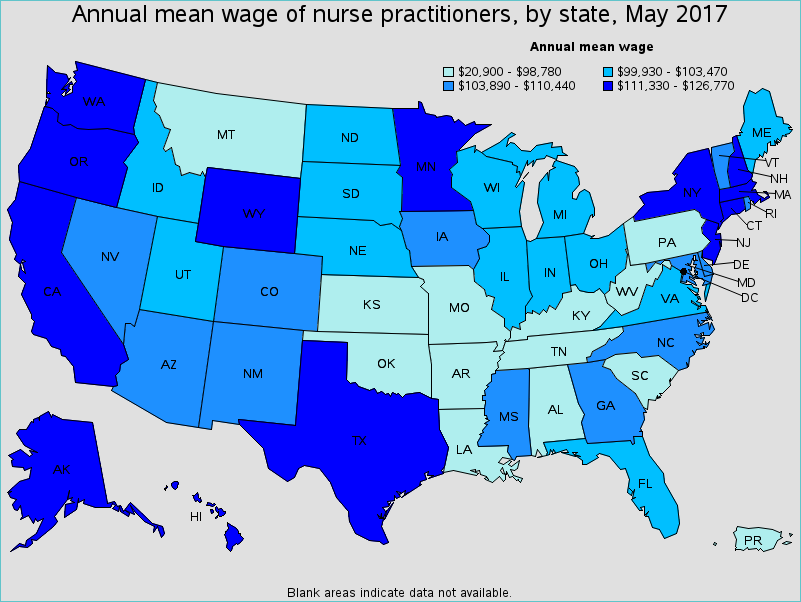
Salary and Job Outlook: Depending on the scope of practice, many NPs earn up to $133,000 a year. The BLS predicts excellent career prospects for registered nurses. Notice in the chart below the projected growth. These jobs are expected to increase at a much higher rate than other occupations for the foreseeable future. The projected employment change from 2016-2026 is 31%. With an advanced degree, salaries and career opportunities are much greater for NPs.

Physician Assistant
Formal Definition: According to the American Academy of PAs, PAs are medical professionals who diagnose illness, develop and manage treatment plans, prescribe medications, and often serve as a patient’s principal healthcare provider. With thousands of hours of medical training, PAs are versatile and collaborative. PAs practice in every state and in every medical setting and specialty, improving healthcare access and quality.
Education Required: PAs are educated at the master’s degree level. There are more than 230 Accredited PA programs in the country and admission is highly competitive, requiring a bachelor’s degree and completion of courses in basic and behavioral sciences as prerequisites. PA programs are approximately 27 months, or three academic years. PA education and training are based on the medical model, and PAs are educated as medical generalists rather than in one specific specialty. Throughout his or her career, PAs have the ability to switch specialties. Note: Most PA programs require at least 1,000 hours of healthcare experience and patient care experience. Incoming PA students bring with them an average of more than 3,000 hours of direct patient contact experience.
Licensure and Certification: Laws vary by state, but all PA’s must complete an accredited education program and pass the national exam prior to practicing.
Primary Job Duties:
- Tracking patients’ medical histories and symptoms
- Examine patients
- Ordering laboratory and diagnostic tests (such as x-rays and blood tests) and analyzing results with physicians
- Providing prescriptions
- Diagnosing a patient’s injury or illness
- Advising patients on preventive health care
- Treating injuries or sicknesses
- Referring patients to specialists as required
- Difference: Currently, most state laws require PAs to have an agreement with a specific physician in order to practice.
Work Environment: PAs work in all medical settings, including (but not limited to):
- Family medicine
- Orthopaedic surgery
- Emergency medicine
- Urgent care
- Internal medicine
- Hospital medicine
- Dermatology
- Cardiology
Salary and Job Outlook: According to the most recent data in AAPA’s 2018 Salary Report, the median base salary for the PA profession is $105,000, and salary varies by practice area, specialty, and experience level. The career outlook for PAs is promising. As one of the fastest-growing occupations of the decade, students can expect to find employment in hospitals, medical offices, and clinics nationwide.


Top Ten Physician Assistant Schools in the United States
| Physician Assistant School | State | Rank |
|---|---|---|
Duke University (USNEWS, ARC-PA) The DU PA program educates caring, competent primary care physician assistants who practice evidence-based medicine, are leaders in the profession, dedicated to their communities, culturally sensitive, and devoted to positive transformation of the health care system.  | North Carolina | 1 |
| University of Iowa (USNEWS, ARC-PA) The University of Iowa's Physician Assistant Program has a student attrition rate below the national average. Upon graduation, the graduates have a 100% employment rate. Our unique program curriculum is purposefully designed to have the PA students complete their didactic curriculum with medical students. | Iowa | 2 |
| Emory University (USNEWS, ARC-PA) The EU School of Medicine Physician Assistant Program is a dynamic program emphasizing active learning centered on the six competencies defined by the profession. Emory offers a MMSc-PA and is one of the few universities to offer a dual degree MMSc-PA/MPH. | Georgia | 3 |
| George Washington University (USNEWS, ARC-PA) The GW MSHS PA program prepares students for clinical careers. The PA/MPH program is a unique three-year program that provides both clinical and academic preparation for careers in medicine and public health. Tracks include: Community Oriented Primary Care, Health Policy, Epidemiology, Environmental Health Science & Policy and Global Environmental Health. | Washington, DC | 4 |
| Oregon Health and Sciences University (USNEWS, ARC-PA) The OHSU Physician Assistant Program, located in Portland, Oregon, is a 26-month, full-time course of study leading to a Master of Physician Assistant Studies degree. A class of 42 students is accepted each year with classes starting in June. The didactic phase of the Program is 12 months; the clinical phase lasts 14 months. | Oregon | 5 |
| Quinnipiac University (USNEWS, ARC-PA) The MHS Physician Assistant Program is focused on building a strong scientific foundation as well as leadership, analytical and interpersonal skills through hands-on clinical experience. Our program will give you both the modern skills to be an indispensable member of a health care team and the cultural awareness necessary to effectively treat diverse populations. | Connecticut | 6 |
| University of Colorado (USNEWS, ARC-PA) The UC College of Medicine offers a CHA/PA Program. The three-year, innovative curriculum of the University of Colorado PA program is designed to integrate clinical and basic sciences to prepare graduates with the knowledge, skills, and attitudes to practice medicine as part of the health care team. The Program confers a Professional Masters Degree (MPAS). | Colorado | 7 |
| University of Utah (USNEWS, ARC-PA) The Utah Physician Assistant Program (UPAP) at the University of Utah School of Medicine is one of the oldest PA programs in the country, and has held continued accreditation since 1971. PAP is committed to training PAs who will be prepared to meet the challenges of providing high quality care to patients in medically underserved and rural communities, and the program has refined its curriculum and format to provide the best combination of didactic and clinical training to accomplish this mission | Utah | 8 |
| University of Nebraska Medical Center (USNEWS, ARC-PA) Our Master of Physician Assistant Studies (MPAS) degree is offered by UNMC at Omaha and Kearney (UNK) campuses. Also offered is a MPAS/MPH dual degree. | Nebraska | 9 |
| Wake Forest University (USNEWS, ARC-PA) The mission of the Wake Forest School of Medicine Physician Assistant (PA) Program is to produce highly capable, compassionate PAs who deliver patient-centered care, make significant contributions to the health care community and continually advance the PA profession. Graduates of the 24-month program earn a Master of Medical Science (MMS) degree. | North Carolina | 10 |
What Career is Right For You?
Prospective students have important decisions to make when it comes to continuing education. Deciding what area of nursing in which to specialize is a good start. A career as a nurse practitioner or as a physician assistant are just two of the many available tracks. The level of autonomy you prefer and how much time you can dedicate to your education are important factors to consider in determining which path is right for you. Some hospitals and medical clinics require NPs to have ten years of experience before starting their practitionership. Alternatively, PAs may start their career after finishing their master’s level program and passing the national certifying exam.
Review our list of accredited master’s in nursing programs to find the best program to help you meet your professional goals and take your career to the next level.